

"...many of the most enticing buildings...are private property. ...they will remain inaccessible - unless you join such a group as the 20th Century Society."
Financial Times
'How to Spend It'

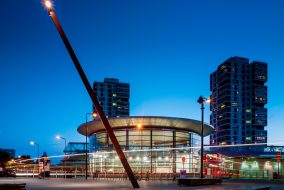
The Twentieth Century Society is deeply concerned about the future of the former NAAFI building in Plymouth, also known as the Hoe Centre. Noted on Plymouth City Council’s Buildings at Risk Register as being of townscape merit, the building narrowly missed being listed in 2006 and is now facing [...] Read more here...
The Autumn C20 Short Course takes place on 16, 23, 30 September. Book online now Read more here...

New Government decision to be disputed.The latest overturn by the Department for Culture Media and Sport (DCMS) of English Heritage’s advice to list a major post war building further fuels the controversy over ministerial involvement in [...] Read more here...

In a move that indicates the new Secretary of State, John Penrose, is not afraid to list post-war architecture, DCMS has just approved the listing of the campus of Leeds University –recognising its significance as the largest and most [...] Read more here...

The churches of the twentieth century are more varied architecturally than those from any other period in this country’s history. Whether their architecture draws on the language of the past or embraces new technology and symbolic shapes that herald the future, they reflect the personal expressions of faith of the architects and patrons that commissioned them, and touch on the changing social and cultural factors that have challenged and shaped faith. Read more here...
As Gavin has said in his article in the Autumn C20 magazine, the battle to preserve Battersea Power Station (BPS) has been one of the Society’s longest running concerns. Whilst the building itself has steadily declined and inched ever closer to ruin, the level of both conservation activity around it and public interest over its possible futures has only grown. Read more here...
Set back from the road and partially screened by trees, a very particular house is “tucked away in suburban Ipswich in a bosky setting almost Californian”, as Alan Powers noted in 1992. Standing as a pavilion in the middle of its elongated wooded site from which it derives its name, The Spinney was designed between 1957 and 1959 and built between January and August 1960 by major regional architect Birkin Haward (Senior) (Ipswich, 16 October 1912 – Ipswich, 9 February 2002) for himself and his family. Read more here...